Your Income
Is Your
Greatest Asset.
Protect It.
Your income supports your home, your family, your business, and the future you're building. But what happens when an illness or injury prevents you from earning it?
Find your coverage belowAlready have disability coverage through work? Check it for income gaps →
Different
Professions.
Same Goal.
Income
Protection.
Disability Insurance Quote Center
Protect Your Income. Keep Your Future Secure.
Compare top-rated carriers and coverage options for your profession. Get personalized quotes in minutes.
Coverage subject to eligibility and underwriting. Listing an occupation does not guarantee coverage.
Thank You! Your Quote Center Is Opening.
We’ve opened your personalized disability quote in a new tab for .
Didn’t Open? Open My QuoteQuestions? Call 866-812-4777 •
Your Personalized Comparison Preview
Not All Disability Insurance Policies Are Created Equal.
Here’s an example of how leading carriers compare. Your personalized results will be based on your occupation, income, and health profile.
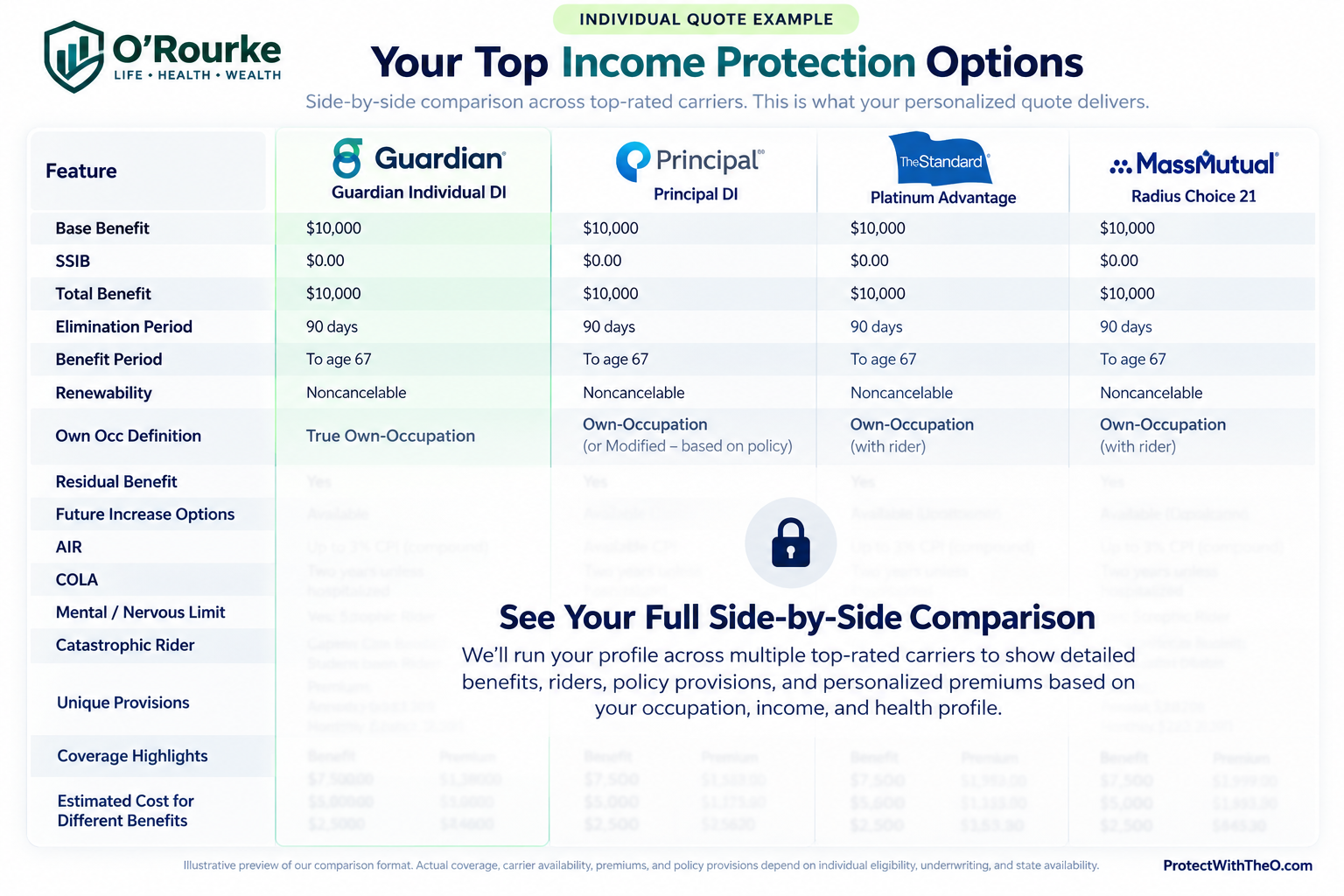
Illustrative preview of our comparison format. Actual coverage, carrier availability, premiums, and policy provisions depend on individual eligibility, underwriting, and state availability.
The Disability Gap
You Have Disability Insurance. But Is It Enough?
Most group disability plans only replace a portion of your income and may not cover bonuses, commissions, or business income. Find out if you have a gap and explore your options.
Check Your Income Gap
What’s
Your
Plan
to
Replace
Your
Income
If
You’re
Too
Sick
or
Injured
to
Work?
The most common responses we hear from business owners and professionals.
I’ll Use My Savings
The average long-term disability claim lasts
34 months.*Could your savings replace nearly three years of income?
I’ll Sell Something
Many business owners believe they could sell their business or other assets.
Do you know what your business is worth — and how quickly you could sell it if needed?
I’ll Figure It Out
Unfortunately, your financial obligations don’t stop when your income does.
Your mortgage, loans, utilities, and everyday expenses continue even when your paycheck stops.
I’ll Use My Employer’s Disability Coverage
It likely covers less than you think.
Most group long-term disability plans replace about 60% of base salary, cap the monthly benefit, and the benefit is taxable if your employer pays the premium. Bonuses and commissions are often not covered.
Illustrative example only: assumes a 60% benefit, a $5,000 monthly maximum, employer-paid premiums, and a 25% combined tax rate on the $60,000 annual benefit. Actual plan provisions, maximums, and taxes vary.
If You Don’t Have a Plan, Plan on Using Your Own Money. Then Your Assets.
*Source: Council for Disability Awareness, Long-Term Disability Claims Review.
If You Couldn’t Work Tomorrow…
Would Your Income Be Covered?
Most people don’t find out what they’re actually covered for until it’s too late. See your estimated numbers — including what group LTD might actually pay — in seconds.

Find out in seconds • No contact info required
*Sources: Social Security Administration (disability odds); Council for Disability Awareness, Long-Term Disability Claims Review (claim duration and illness share).
Which situation applies to you?
Select your coverage status and we'll walk you through your real numbers.
Tell us about your situation
We'll calculate your real take-home benefit — including benefit caps, the tax hit, and your elimination period.
Two things your group plan won't tell you
Before the numbers — here's why group LTD can deliver less than people expect.
When your employer pays the LTD premiums, benefits are generally taxed as ordinary income, just like your paycheck. Your stated benefit is not what lands in your bank account.
Many group plans define disability as "unable to do your own occupation" for only the first 24 months. After that, the definition often shifts to "any occupation" you're reasonably suited for by education, training, or experience. If you can do that work, even for less pay, benefits may stop.
Your real income gap
What you think you'd receive vs. what would likely reach your bank account.
The true cost over time
A monthly shortfall feels manageable. Watch what it compounds to.
Coverage quality — group LTD vs. individual DI
The amount your plan pays is only half the story. What it won't pay matters just as much.
Employer-paid = taxable income
Can't do YOUR specific job
Many plans cap regardless of salary
Benefit keeps pace with inflation
Partial benefit if working part-time
A condition that develops while on a group plan can make you uninsurable individually the moment that job ends — even if you've never filed a claim.
The savings reality check
If your group benefit doesn't cover your essential expenses, how long would savings bridge the difference?
Your coverage gap summary
Carriers limit total coverage (group + individual) to a share of your earned income, typically around 60–70%. Estimate shown before underwriting.
Tell us about yourself
We'll show you exactly how much income is exposed — and what the numbers look like over time.
Your disability risk
Most people believe disability won't happen to them. The numbers say otherwise.
More than 1 in 4 of today's 20-year-olds will become disabled before reaching retirement age (Social Security Administration)
Your income at risk
What your monthly income looks like if you become disabled today — with nothing in place.
The true cost over time
A monthly income loss feels abstract. Watch what it adds up to over the years.
The savings reality check
With no coverage, you'd be covering all expenses from savings. How long does that last?
Your income protection summary
Specialized Disability Insurance Programs
More Than a Quote. Solutions for Your Profession, Business & Income.
From guaranteed standard issue programs to complex underwriting, we help individuals, professionals, and business owners access specialized disability insurance solutions.
Guaranteed Standard Issue (GSI) Programs
Specialized disability insurance programs for eligible professionals, including medical, legal, and other qualifying groups. Coverage may be available without individual medical underwriting.
Protection for the People Who Build Businesses
Disability income solutions for contractors, skilled trades, and business owners, including available occupational and multi-life discounts.
Protect Your Business Financing
Disability insurance strategies designed to help business owners maintain loan payments and protect cash flow when illness or injury interrupts their ability to work.
Disability Benefits for Your Workforce
Group and supplemental disability insurance solutions designed to help employers protect employees’ income and address gaps in existing benefits.
Better Options Through Group Participation
Explore available multi-life pricing, simplified underwriting, and employer-sponsored arrangements for eligible businesses and professional groups.
Specialized Solutions for Challenging Cases
Specialist support for medically complex, high-benefit, previously declined, and challenging occupation cases.
Prefer to talk now? Call 866-812-4777
Access to Top-Rated Disability Insurance Carriers
We compare your profile across multiple top-rated carriers at once — helping you find the coverage that fits your occupation, income, and health profile before you apply.

Not limited to one company. As an independent agent, I compare these carriers side by side to help you find coverage that fits your needs and budget.
Get My Free QuoteCarrier availability varies by state, occupation, and underwriting. Logos are trademarks of their respective companies.
Frequently Asked Questions
Everything you wanted to know about income protection — answered in plain English.
In many cases, yes — and the gap is often larger than people expect.
When an employer pays the LTD premiums, benefits are generally taxable as ordinary income. Once taxes, monthly benefit caps, offsets, and excluded pay are factored in, actual take-home replacement can be significantly lower than the stated 60% — especially for higher earners.
Many group plans cover base salary only, so bonuses, commissions, and other variable pay may be excluded. Many also switch to an “any occupation” definition after 24 months.
An individual supplemental policy can help fill those gaps with portable coverage you own personally, and benefits that are generally income-tax-free when you pay the premiums with after-tax dollars. Check your income gap to see your estimated numbers.
Group LTD usually ends when you leave the employer, and some plans offer only limited conversion options. If your health has changed by then, getting new coverage can be harder or more expensive.
An individual policy goes with you — to a new job, a new practice, or your own business — as long as you keep paying the premium.
Social Security Disability Insurance (SSDI) pays disabled workers an average of about $1,630 per month (2026 estimate), after a 5-month waiting period. Many applicants are denied at first and must appeal, which can take a long time.
SSDI also uses a strict definition — you generally must be unable to do any substantial work, not just your own job.
Individual disability insurance pays based on your own income, can use an own-occupation definition, and begins after the elimination period you choose.
Source: Social Security Administration.Workers’ compensation only covers work-related injuries and illnesses. If you’re diagnosed with cancer, have a heart attack, or are hurt off the job, workers’ comp generally pays nothing.
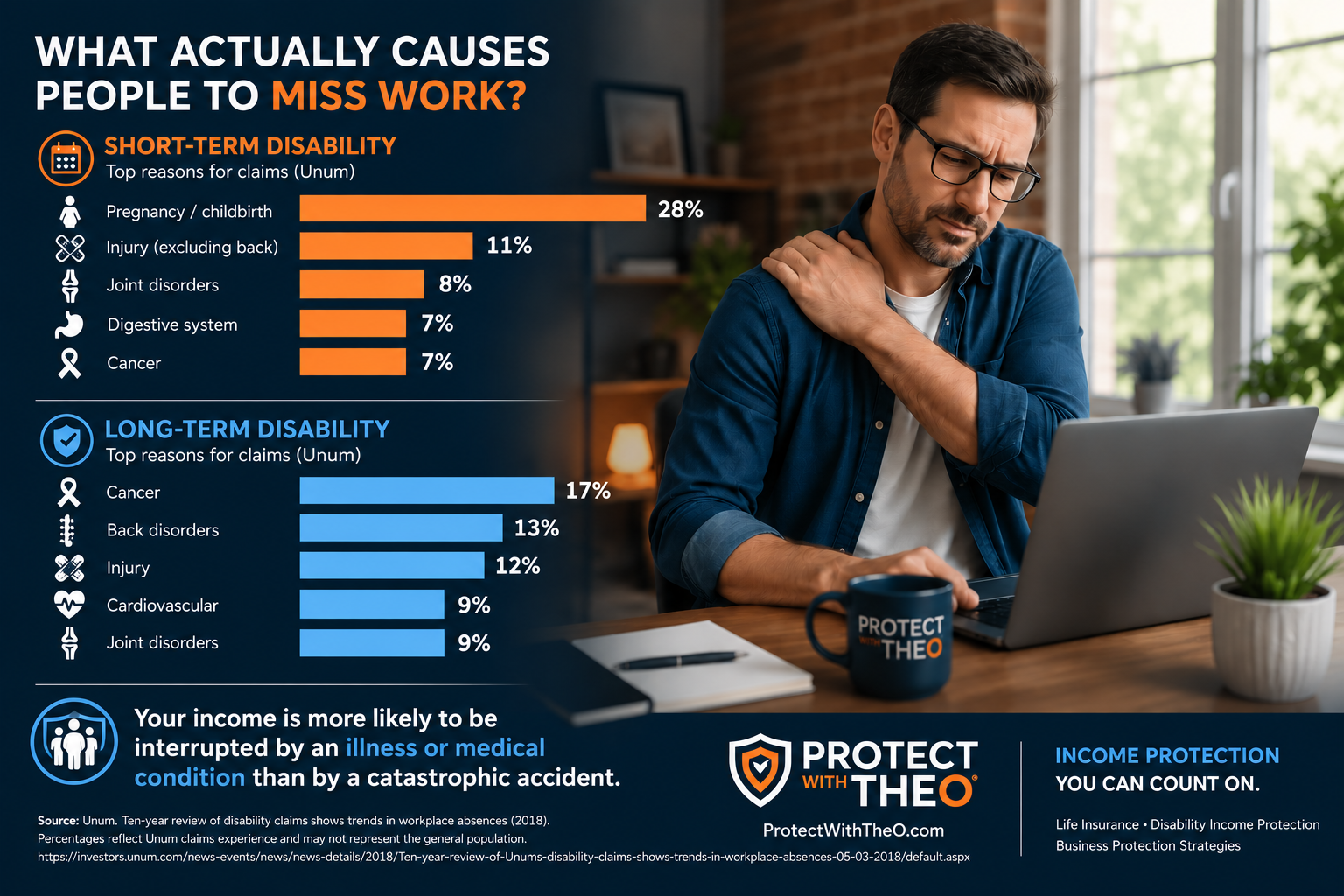
Most long-term disability claims are caused by illness, not accidents. Disability insurance covers you whether the disability happens at work or not.
Source: Council for Disability Awareness, Long-Term Disability Claims Review.Own-occupation means the policy pays if you can no longer perform the duties of your specific profession — even if you could work in a different role.
Example: a surgeon who loses the use of a hand can no longer operate. Under true own-occupation coverage, they can still be considered disabled — even if they could teach or consult.
Any-occupation is much stricter: you must be unable to do any job you’re reasonably suited for. Many group LTD plans start with own-occupation for 24 months, then switch to any-occupation. That change is one of the most important things to understand about workplace coverage.
Individual policies with own-occupation language can provide much stronger protection for professionals whose income depends on a specific skill set. Definitions vary by carrier and policy.
The elimination period is the waiting period before benefits begin — like a deductible measured in time instead of dollars.
Common options are 30, 60, 90, or 180 days. A longer elimination period lowers your premium but means you’ll need savings to cover the gap. The right choice depends on your emergency fund and how quickly you’d feel the pressure if your paycheck stopped.
The benefit period is how long monthly payments can continue once you qualify. Options range from short periods such as 2 or 5 years to coverage that runs to age 65, 67, or — with some carriers — age 70.
The average long-term disability claim lasts about 34.6 months, but serious conditions can last much longer. A benefit period to age 65, 67, or 70 is designed to protect you all the way to retirement, while a shorter 2- or 5-year period can make sense — and cost less — if you’re closer to retirement or mainly want to bridge a temporary gap. We compare options so you can find the right balance for your budget.
Source: Council for Disability Awareness, Long-Term Disability Claims Review.Noncancelable means that as long as you pay your premiums, the carrier can’t cancel your policy, change its provisions, or raise your premium during the guaranteed period.
Guaranteed renewable means the carrier can’t cancel your policy or change its provisions, but it may raise premiums for an entire class of policyholders — not just you.
Noncancelable coverage typically costs a bit more, but it locks in your rate.
It depends on who paid the premiums. If your employer paid them — as with most group LTD plans — benefits are generally taxable as ordinary income.
If you pay the premiums with after-tax dollars on an individual policy, benefits are generally income-tax-free. That difference alone can be worth hundreds of dollars a month during a disability.
This is general information, not tax advice — consult your tax professional about your situation.
No — and this is where good policies separate from okay ones. Two policies with the same monthly benefit can pay very differently at claim time because of the contract language.
Key differences include the definition of disability, how and when residual benefits start, mental/nervous limitations, how the benefit grows with inflation, and which riders and unique provisions are included.
That’s why we compare the actual policy terms side by side — not just the price.
Both pay when you can still work but your ability or income is reduced — they just measure it differently.
Partial disability is usually based on your ability to perform some of your duties or work part-time, and often pays a flat percentage of the benefit for a limited time.
Residual disability is based on your loss of income. If an illness or injury reduces your earnings, it pays a proportionate share of your benefit. Many recoveries are gradual, so this is one of the most valuable features to compare.
This is where contracts differ the most. Points to compare:
When it starts: Many policies begin residual benefits once you lose a minimum amount of income — commonly around 15% to 20%. Some require a period of total disability first; stronger policies do not.
How much it pays: Usually a percentage of your monthly benefit equal to your percentage of lost income. Many policies treat a loss of about 75% to 80% or more as a full loss and pay the full benefit.
Early-claim protection: Some pay at least 50% of the benefit for the first several months, even if your income loss is smaller.
Recovery benefit: Some keep paying after you return to full-time work if your income hasn’t fully recovered.
Exact thresholds and durations vary by carrier and contract.
A cost-of-living adjustment (COLA) rider increases your monthly benefit each year while you’re on claim, helping your benefit keep pace with inflation during a long disability.
Riders differ in the increase rate (often tied to CPI, with a cap such as 3% to 6%), whether increases are simple or compound, and how long increases continue. A compound COLA can make a big difference on a claim that lasts years.
These let your coverage grow before a claim, while you’re healthy and working.
An Automatic Increase Rider (AIR) raises your benefit automatically for a set number of years — often around 3% per year — without new medical underwriting. You can usually decline an increase.
A future increase option lets you buy additional coverage later as your income rises, typically with financial proof but without new medical underwriting. These are especially valuable for residents, early-career professionals, and growing business owners.
Many policies cover mental and nervous disorders and substance-related conditions, but limit benefits for them — commonly to 24 months over the life of the policy, unless you’re hospitalized.
Some carriers offer longer or no limitations, or riders that adjust the limit. Because mental health is a growing cause of claims, this is an important term to compare.
A catastrophic disability rider pays an additional monthly benefit on top of your base benefit if you suffer a severe disability — typically loss of the ability to perform two or more activities of daily living, severe cognitive impairment, or a presumptive loss such as sight, hearing, speech, or use of limbs.
Severe disabilities often bring higher costs for care and home changes, and this rider helps cover them.
Beyond the core benefit, some carriers offer provisions that can add real value — availability and terms vary by carrier:
Family care benefit: helps if you need to reduce work to care for a seriously ill family member.
Student loan rider: helps make student loan payments while you’re disabled — popular with physicians, dentists, and other professionals.
Unemployment premium waiver: may waive your premiums for a period if you involuntarily lose your job.
Others include retirement contribution protection, return-of-premium options, and benefits for transplant or organ donation. We’ll show you which provisions each carrier includes in your comparison.
Often, yes. A past decline or a health condition doesn’t automatically mean you can’t be covered — it means you need someone with access to the right markets.
We work with simplified issue products that may consider many common conditions with no medical exam or blood work, along with specialty markets — including Lloyd’s of London — for high-risk occupations and hard-to-place cases. Approval is always subject to underwriting.
In our quote center, choose the closest match or “Other / Not Listed” and continue — or call 866-812-4777. Carriers classify occupations by your actual daily duties, so we’ll help you find the right classification. Being listed doesn’t guarantee eligibility, and not being listed doesn’t rule you out.
Yes — and self-employed people often need it most. Without employer-provided group LTD, your income has no built-in safety net.
The main consideration is income documentation. Carriers typically review tax returns to set your insurable income, so write-offs that lower reported income can also lower how much coverage you qualify for. We help self-employed clients navigate this, including options for variable income.
Often, yes. Many carriers issue coverage into your late 50s and 60s, with benefit periods that typically run to age 65 or 67. Premiums are higher than for younger applicants.
The final working years are often when income is highest and retirement savings are most exposed — a disability then can permanently change your retirement plans, so coverage is worth reviewing.
Yes. Beyond personal income protection, there are business-focused policies such as business overhead expense coverage (helps pay rent, payroll, and other ongoing costs while you recover), loan protection (helps keep loan payments current), and disability buy-out coverage for partners.
These can help keep your business running — and your lender satisfied — if you can’t work.
Yes — and they’re often underused. When several people apply together — colleagues, employees, or partners — many carriers offer a multi-life discount on each individual policy. No formal group plan is required, and each person owns a portable policy.
For eligible larger groups, Guaranteed Standard Issue (GSI) programs may allow coverage without individual medical underwriting. Requirements vary by carrier.
If you’re a business owner, employer, or part of a professional association, it’s worth a conversation.
Individual disability insurance often costs roughly 1% to 3% of annual income, but your actual premium depends on your age, occupation, health history, benefit amount, elimination period, benefit period, and riders.
The most accurate way to know is to run your profile across multiple carriers — which is exactly what our free quote does. You see real numbers before committing to anything.
It depends on the underwriting path. With simplified or accelerated issue products, qualified applicants may be approved in days.
Fully underwritten policies typically take several weeks, depending on the carrier, health history, and benefit amount. We identify your likely path before you apply, so there are no surprises.
No fee to you. Like other independent insurance agents, Greg is paid a commission by the carrier when a policy is issued. Premiums are set by the carrier and filed with the state — working with an agent doesn’t add to your cost.
What you gain is access to multiple carriers, guidance on which policy fits your situation, and ongoing service from someone who knows your file.
Still Have Questions? Let’s Talk.
A short call can answer what’s specific to you — your occupation, income, health history, and what coverage actually makes sense.